
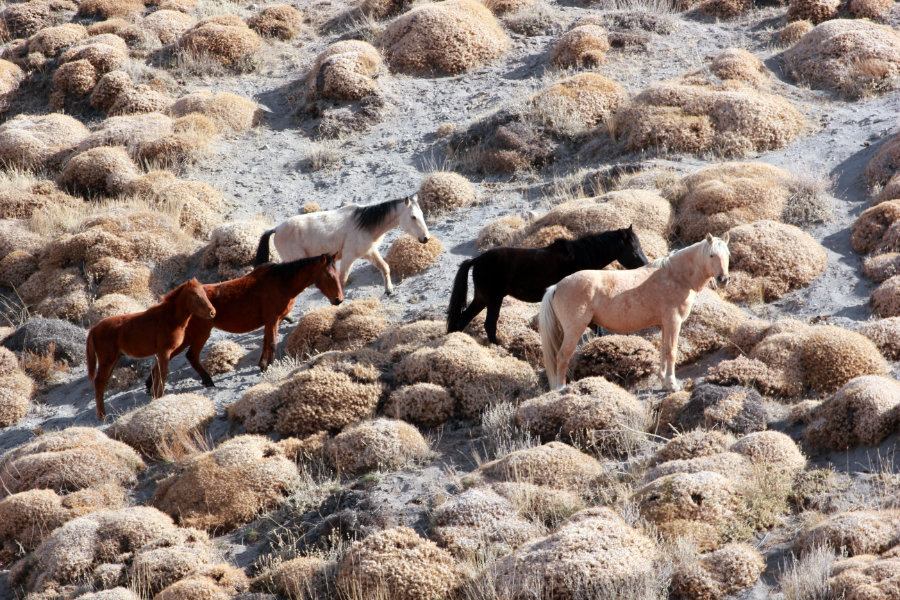
Q: Where are America’s remaining wild horses and burros?
A: Today, wild horses and burros can be found primarily on government-designated Herd Management Areas (HMAs) in ten western states: Arizona, California, Colorado, Idaho, Montana, Nevada, New Mexico, Oregon, Utah, and Wyoming. Six states have already lost their entire wild horse populations.
Q: Is there an overpopulation of wild horses on public lands?
A: Wild horses comprise a minute fraction of grazing animals on public lands, where they are sometimes outnumbered by cattle by upwards of 50 to 1. The Wild and Free-Roaming Horses and Burros Act states that, in a given area, a certain amount of vegetation may be eaten as forage. Only when that amount is exceeded are there too many animals. The Bureau of Land Management (BLM) has favored cattle in setting “appropriate” wild horse population levels, resulting in the indiscriminate removal of horses and burros from public lands. From over 2 million wild horses on the range in 1900, by some accounts, our wild horse population now stands at 95,000 by BLM’s estimate.
Q: Aren’t wild horses suffering from drought and starvation out on the range?
A: Mismanagement is at the root of most of these problems. Despite federal protection, wild horses have been relegated to the most inhospitable areas of the range. Still, they have adapted and survived; most horses rounded up by the BLM are well-fed and healthy. However, public land fencing often prevents horses from accessing scarce natural water sources and disrupts their widespread grazing patterns. In such instances, better in-the-wild management is the answer, rather than costly and traumatic round-ups.
Q: Are wild horses responsible for overgrazing on public lands?
A: The main cause of the degradation of public lands is livestock use, not wild horses. Cows graze within a mile of water, while wild horses are highly mobile, grazing from five to 10 miles from water, at higher elevations, on steeper slopes, and in more rugged terrain. A congressionally-mandated study by the National Academy of Sciences found that, in one year, livestock consumed 70% of grazing resources on public lands, while wild horses and burros consumed less than 5%.
Q: Is it true that wild horse herds double in size every five years and have no natural predators?
A: In its 1982 study, the National Academy of Sciences found “annual rates of increase of 10% or less” in wild horse populations, a far cry from the 20% increase relied upon by the BLM to justify its removal program. Wild horses do have predators, in the form of mountain lions and bears. In 2004, for instance, only 1 out of 28 foals survived in Montana’s Pryor Mountain area. Such a low survival rate was mostly due to mountain lion predation.
Q: Aren’t wild horses a non-native species?
A: Wild horses are a reintroduced native wildlife species. A growing body of evidence shows that the horse originated in North America some 53 million years ago and traveled over the Bering Land Bridge, dispersing into Asia 800,000 to 1 million years ago. DNA evidence shows that the horse remained in North America at least as recently as 5,000 years ago. How they disappeared — if, in fact, they actually ever became extinct here — is a mystery. When Cortez landed in Mexico in 1519, he brought horses from Spain. Others followed. From these reintroduced animals came the great numbers of wild horses that eventually changed the culture of the Plains Indians. The Spanish horses soon adapted to the same ecological niche their native relatives had once thrived in. Long before the early settlers pioneered the West, they were here as a reintroduced, fully adapted wildlife species, upwards of 2 million strong by one often-cited estmate.
Q: But isn’t the modern horse species a different one from the one that disappeared so long ago?
A: Most of those early differing species were genetically equivalent. Modern molecular biology, using mitochondrial DNA analysis, has shown that the genetic equivalent of Equus caballus emerged, diverged as a species, about 1.6 million years ago. Even more recent molecular work has shown that the very latest the modern horse could possibly have diverged was about 300,000 years ago. DNA evidence shows that the horse remained in North America at least as recently as 5,000 years ago.
Q: How are wild horses different from domestic horses?
A: The result of 500 years of natural selection, the American wild horse distinguishes itself from domesticated horses by both its morphology and its behavior. Natural selection has preserved the hardy traits of the horses that shaped the American West: a 1998 Kansas State University study found that wild horses are far less affected by bone disease than their domestic counterparts; wild horses also distinguish themselves by the remarkable hardness of their hooves. In addition, a University of Kentucky study has shown that, despite intense culling, wild horse herds are still genetically far more diverse than any breed of domestic horse. Some herds such as Utah’s Sulphur Spring herd are a direct link to the primitive Iberian horse and have been recognized by geneticists as a resource of “truly unique and irreplaceable genotypes, a zoological treasure.” These horses retain many traits of the endangered Sorraia breed, including triple dorsal stripes, zebra-striped legs and chest barring.
Q: What about burros?
A: Wild burros’ situation is even more precarious than that of their wild horse cousins. Descendants of the burros used by miners as pack animals in the 1800s can still be found in Nevada, Arizona, and California, where they share their habitat with bighorn sheep, a highly-prized hunted species that outnumber them on public lands. Under pressure from the hunting lobby, BLM consistently removes burros from their legally allocated range to increase the number of available bighorn hunting tags; BLM has set the population target for burros at less than 3,000 nationally. Meanwhile, the National Park Service has a zero wild burro policy: burros found on lands managed by that agency are routinely shot in an eradication program labeled “direct reduction.”