


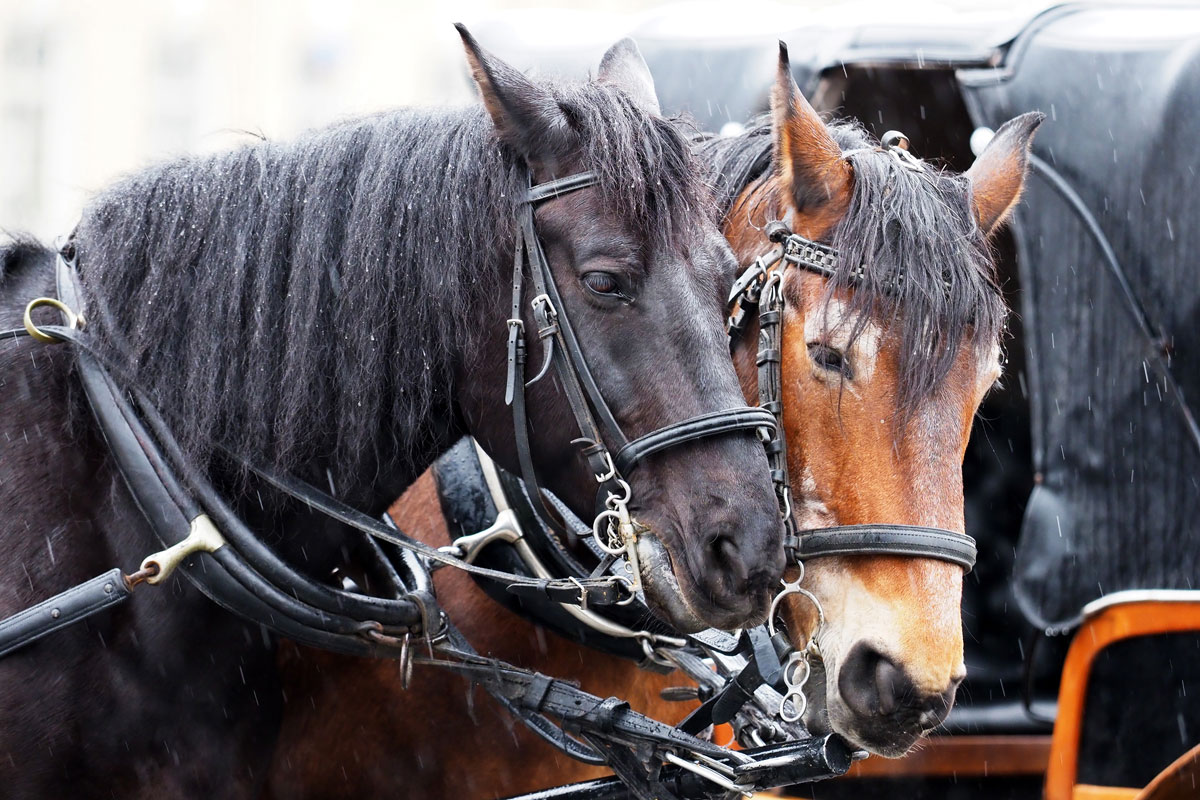
Today’s city carriage horses often live miserable lives working more than nine hours a day, seven days a week, pulling a heavy carriage that weighs hundreds of pounds, on busy streets in heavy traffic, pounding hard pavement, with loud frightening noises, deprived of fresh, clean drinking water, breathing toxic exhaust fumes, working in extreme heat and cold temperatures, and resting at night in deplorable housing with too little room to physically move and rest. City streets are no places for horses.
Plus, carriage horses aren’t protected under the federal Animal Welfare Act, and anti-cruelty laws offer very few safeguards, and humane agencies like the ASPCA don’t have the resources to monitor this industry. Carriage horse operators and drivers see their horses as money-making, tax-free cash machines, and if the horse is no longer “useful” or too lame from working, then they just dispose of them, and replace them. Many cities have no regulations for carriage horses, and they suffer and die from heat exhaustion, sun stroke, dehydration, accidents, collisions, driver error, and fatigue. Then, finally, if this isn’t bad enough, many operators sell their old, injured, and spent horses for slaughter because they no longer are bringing in revenue for them. Simply put, they are discarded.
If you are considering a carriage horse ride, please think again. Do you really want to support these horses’ suffering? Who is looking out for them? Not the driver, or the operator, or the city, or you, the patron. The only meaningful, humane, and moral response to this abusive industry is a complete ban on horse-drawn carriages that will protect and respect the horses. Instead, consider one of the alternatives listed below that don’t cause pain and suffering to animals.
Major Concerns, Threats, and Dangers for Carriage Horses
- Traffic Accidents—Because horses are prey animals, they spook easily from any sudden and loud sound, barking dogs, sirens, and street noise. Terrified, they bolt and run down city streets, causing accidents where both people and horse get injured. Many carriage horses have been severely injured and had to be euthanized or have died from their wounds on city streets. See below for some recent examples.
- Overworked & Exhausted— Horses work long nine-hour shifts in busy city streets on hard pavement and suffer from exhaustion and collapse from fatigue. They are often pushed too hard and overworked, which can be exacerbated by extreme heat rising from the pavement and high air temperatures. They are living animals who do not belong on busy, heavily trafficked city streets.
- Heat Stroke—Horses suffer from heat exhaustion and heat stroke in warm/hot weather and during hot summer months and cannot recover from the constant exposure to heat from the pavement as well as the air temperature. Coupled with dehydration, they can collapse from heat exhaustion and fatigue.
- Breathing Toxic Car Fumes—For 9-10 hours a day, horses are breathing toxic nose-to-tailpipe polluting car exhaust fumes that suffocate them and cause respiratory distress and lung disease.
- Extreme Dehydration—Carriage horses working in towns often don’t get enough clean, fresh water, and suffer from mild to extreme dehydration, causing collapse.
- Underfeeding—Many carriage horses are underfed and undernourished for the amount of labor they do, working nine hours a day pulling a load of hundreds of pounds.
- Constant Pounding on Hard Pavement—The constant walking and trotting on cement and asphalt nine hours a day causes concussive injury to horses’ legs and feet, which are designed to walk on soft surfaces like dirt or grass. Pulling heavy carriages on pavement causes debilitating leg injuries and concussive injuries that makes them lame and arthritic, and subjects them to constant pain and suffering. Some become so lame, they are unable to walk any longer.
- Lack of Shade to Cool Off—During hot summer months, carriage horses need cool places to rest and recover and keep their body temperatures regulated. But most city carriage horses bake in the sun for hours, while resting and working, never getting a break. Many carriage horses collapse and die from the heat.
- Subjected to Massive Street Dangers—Horses have stepped on electric plates and died, and are terrified of sudden and loud noises and sights—ambulance sirens, racing police cars, drivers running red lights, flashing lights, potholes, barking dogs, fireworks, yelling, whistles—all posing severe dangers for horses and the carriages.
- Dangerous Weather Conditions—Horses are forced to work in all kinds of harsh, extreme, and dangerous weather conditions—snow, icy, sleet, rain, heat, freezing cold—where they should not be working at all.
- Horse Stables Can be Dangerous, Inadequate, and Hazardous—Carriage horses are often stabled in sub-standard housing for their needs; stalls are too small, forcing them to stand, and there is not enough space for them to lie down and stretch out to recover from the all-day labor. Often, horse stalls aren’t cleaned regularly or properly, and many are fire hazards.
- Drivers Don’t Often Pay Attention—Drivers are on cellphones, reading newspapers, making illegal turns, and otherwise driving illegally.
WHAT YOU CAN DO
• Don’t take carriage horse rides. Don’t patronize or support this industry.
• Learn more about the issue by visiting and subscribing to the Coalition to Ban Horse-Drawn Carriages. “Like” its Facebook page.
• Visit and subscribe to Horses Without Carriages International for more about the plight of carriage horses worldwide.
• Report animal abuse and horse abuse in NYC; here’s how.
• Sign petitions to ban horse-drawn carriages in the towns that sponsor them.
• See the list of accidents involving horse-drawn carriages at NYClass and Coalition to Ban Horse-Drawn Carriages in the past 10 years.
• Share on social media to help raise awareness about carriage horse abuse so laws can be passed to ban carriage horses, and replace them with vintage cars and bicycle-powered carriages.
• Watch the award-winning documentary, BLINDERS, about NYC’s carriage horse industry.
• If you live in a city where carriage rides are still allowed, contact your local legislators to ask them to sponsor a ban. Many cities—including Biloxi, Mississippi; Camden, New Jersey; Key West, Palm Beach, Pompano Beach, and Treasure Island, Florida; and Salt Lake City—have already banned horse-drawn carriage rides.
Alternatives to a Carriage Horse Rides That Don’t Hurt Horses
Take a walk
Take a tour
Ride a bike
Take a pedicab tour
Take a Hop On, Hop Off Tour
Take a boat tour
Have a picnic
Visit a sanctuary or do something that supports animals
Cities That Have Banned Horse-Drawn Carriages
Beijing, China
Biloxi, MS
Broadway at the Beach, SC
Camden, NJ
Deerfield Beach, FL
Key West, FL
Kenneth City, FL
Las Vegas, NV
London, England
Oxford, England
Palm Beach, FL
Panama City Beach, FL
Paris, France
Pompano Beach, FL
Reno, NV
Salt Lake City, UT
Santa Fe, NM
Toronto, Canada,
Treasure Island, FL
Quotes About Horse-Drawn Cruelty
“The life of a carriage horse is extremely difficult and life-threatening, and the ASPCA has long believed that carriage horses were never meant to live and work in today’s urban setting.” ~ American Society for the Prevention of Cruelty to Animals (ASPCA)
“The horses in NYC are worse off now in the 21st Century than they were 100 years ago.” ~ Animal Welfare Expert (Source: BLINDERS film)
“These horses are beasts of burden and have just a horrible life.” ~ Animal Welfare Advocate (Source: BLINDERS film)
“These carriage operators and drivers desensitize themselves to horse abuse because that’s how they make a living.” ~ Animal Welfare Expert (Source: BLINDERS film)
“Many carriage horses have pre-existing lameness, then they are put onto pavement and hard cement, causing concussive injury, constantly. Working a lame horse is illegal and inhumane. It’s very cruel.” ~ Veterinarian (Source: BLINDERS film)
“Tradition is a really lame excuse for animal cruelty. Bullfighting was a tradition that was extremely cruel.” ~ Animal Welfare Expert (Source: BLINDERS film)
“In my professional opinion, these horses are money-making commodities and they are treated as such.” ~ Animal Care Expert (Source: BLINDERS film)
Jennie Richards is the Founder of Humane Decisions and Homeless to Housecats, the former of which is devoted to ending the suffering, domination, exploitation, abuse, enslavement, and use of animals worldwide for reasons of food, pleasure, convenience, entertainment, and all other exploitative reasons.
Humane Decisions provides resources and information to shift both individual and collective consciousness and actions to living a fully compassionate life that is completely free of animal products and one that recognizes animal sentience and inclusion in our moral community.
For more information, visit Humane Decisions.